Baby Boomers Born 1946–1964
How old are Baby Boomers?
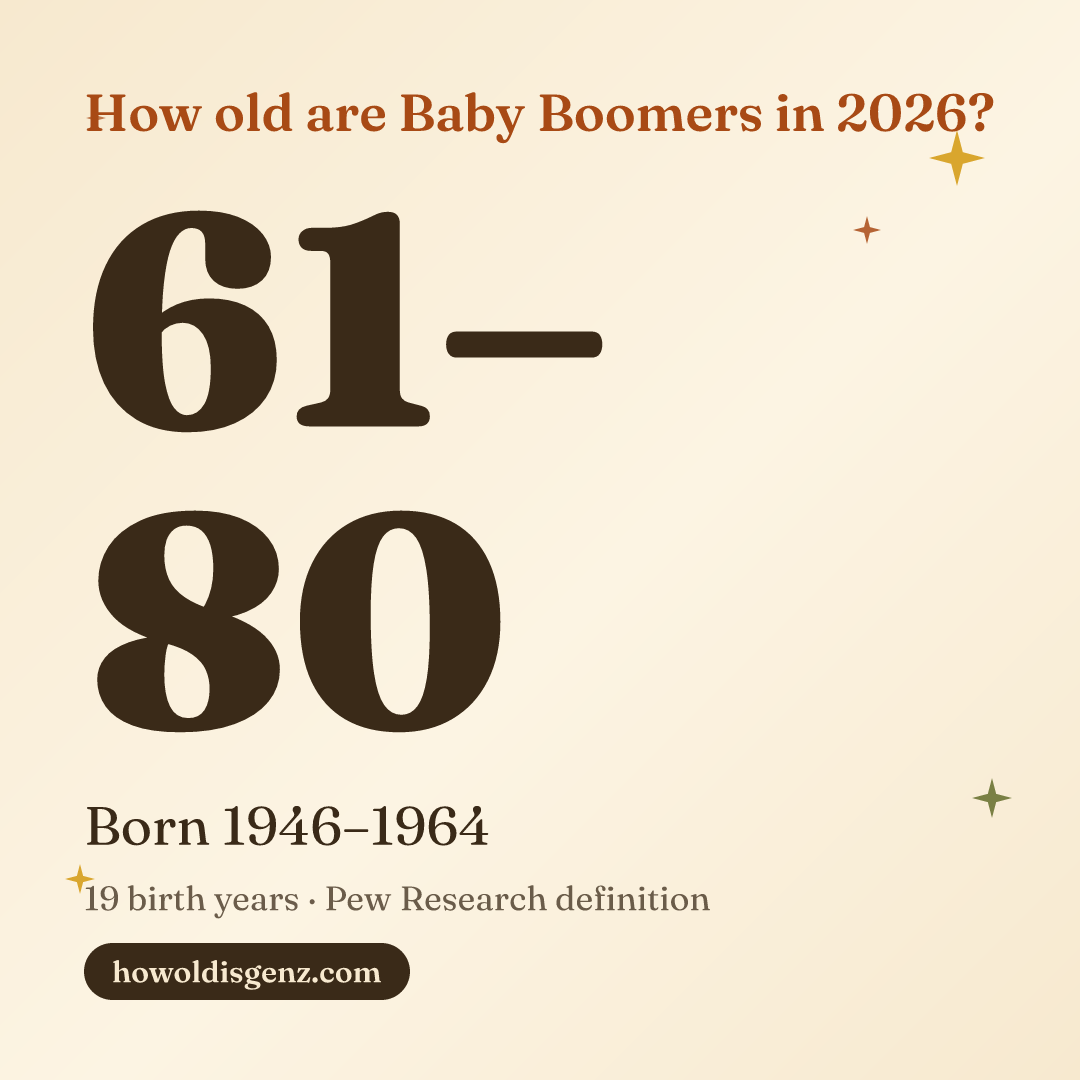
Baby Boomers were born from 1946 to 1964, which means they are currently aged between 61 and 80.
Ages current as of September 23, 2026 · The only generation with an official US Census Bureau definition.
Baby Boomers were born into postwar optimism and rationed television, then proceeded to reinvent every institution they passed through — and to soundtrack it. They watched the moon landing live, fought over and against the Vietnam War, and are now the generation whose oldest members are turning 80.
Quick facts
- Birth years
- 1946–1964
- Ages in 2026
- 61 to 80 years old
- Generation before
- The Silent Generation (1928–1945)
- Generation after
- Generation X (1965–1980)
- US population
- ≈64 million About 19% of the US population (2024 estimates); Boomers were the largest generation in American history until Millennials passed them.
- Where the name comes from
- Named for a literal boom: births in the US surged after World War II, from 2.8 million in 1945 to 3.4 million in 1946, and stayed high for 18 years — about 76 million babies in all. The press called it the 'baby boom,' and the babies became Boomers.
- Also known as
- Boomers · the Me Generation
Famous members of Baby Boomers
Every one of them born between 1946 and 1964.
-
Oprah Winfrey
b. 1954Film & TV
Turned a Baltimore talk show into a media empire
-
Steve Jobs
b. 1955Tech
Co-founded Apple in his parents' garage in 1976
-
Bill Gates
b. 1955Tech
Dropped out of Harvard to start Microsoft
-
Michael Jordan
b. 1963Sport
Six NBA titles; the last Boomer-born sports icon
-
Madonna
b. 1958Music
Four decades of reinvention, from 'Holiday' onward
-
Michael Jackson
b. 1958Music
Thriller is still the best-selling album ever made
-
Barack Obama
b. 1961Politics
44th US president, born in the boom's final years
-
Meryl Streep
b. 1949Film & TV
A record 21 Academy Award acting nominations
-
Tom Hanks
b. 1956Film & TV
America's dad, from Splash to Apollo 13
The culture that raised them
Movies
- The Graduate 1967 Alienated youth, one word: plastics
- Easy Rider 1969 The counterculture hits the highway
- Jaws 1975 The first modern summer blockbuster
- Star Wars 1977 Boomer-made myth that raised every generation since
TV
- Leave It to Beaver 1957 The suburban childhood, idealized in black and white
- The Ed Sullivan Show 1948 Where 73 million of them watched the Beatles land in 1964
- Saturday Night Live 1975 Boomer humor goes live from New York
Music
- The Beatles on Ed Sullivan 1964 73 million viewers — about 40% of the country — in one night
- Motown Records 1959 Detroit's hit factory scored the generation's youth
- Woodstock 1969 Three days, 400,000 people, one muddy defining myth
Books
- The Catcher in the Rye 1951 Holden Caulfield, patron saint of teenage disaffection
- On the Road 1957 The Beat blueprint for dropping out and heading west
- To Kill a Mockingbird 1960 Assigned to every Boomer, and everyone since
You probably didn't know
The non-obvious markers — the stuff only Baby Boomers remembers.
-
They practiced hiding from the atom bomb
'Duck and cover' drills — taught by Bert the Turtle in a 1951 civil-defense film — were a routine part of Boomer elementary school.
-
Their draft numbers were drawn on live TV
On December 1, 1969, the first draft lottery since WWII assigned call-up order by birthday, broadcast to the nation. A blue capsule could reroute your life.
-
Music got personal in 1954
The Regency TR-1, the first mass-market transistor radio, let teenagers take rock 'n' roll out of the family living room — the distant ancestor of the earbud.
-
The hula hoop moved 25 million units in four months
Wham-O's 1958 craze is still shorthand for how fast a fad could sweep 1950s suburbia.
-
Coonskin caps were the fidget spinners of 1955
Disney's Davy Crockett series set off a merchandising frenzy — at the peak, caps reportedly sold by the thousands per day.
-
There were 76 million of them
Between 1946 and 1964, US hospitals delivered roughly 76 million future Boomers — a demographic wave that reshaped schools, suburbs, and eventually Social Security.
The events that shaped Baby Boomers
-
Sputnik
The Soviet satellite set off the space race and rewired American math and science education around beating Moscow.
-
Cuban Missile Crisis
Thirteen October days when the Cold War nearly turned hot — Boomer kids practiced drills while their parents watched the news.
-
JFK assassinated
November 22, 1963: the 'where were you' moment of the Boomer childhood.
-
Civil Rights Act
Landmark legislation outlawing segregation and discrimination, passed as the oldest Boomers entered high school.
-
Moon landing
July 20, 1969: Apollo 11 put Armstrong and Aldrin on the Moon before a global audience of hundreds of millions.
-
Kent State
National Guardsmen killed four students at an anti-war protest, a breaking point in the generation's relationship with authority.
-
Vietnam withdrawal
US combat involvement ended after a war that drafted, divided, and defined Boomer men — 2.7 million of whom served.
-
Nixon resigns
Watergate ended a presidency and hard-coded a generation's skepticism of institutions.
What things cost when Baby Boomers turned 25
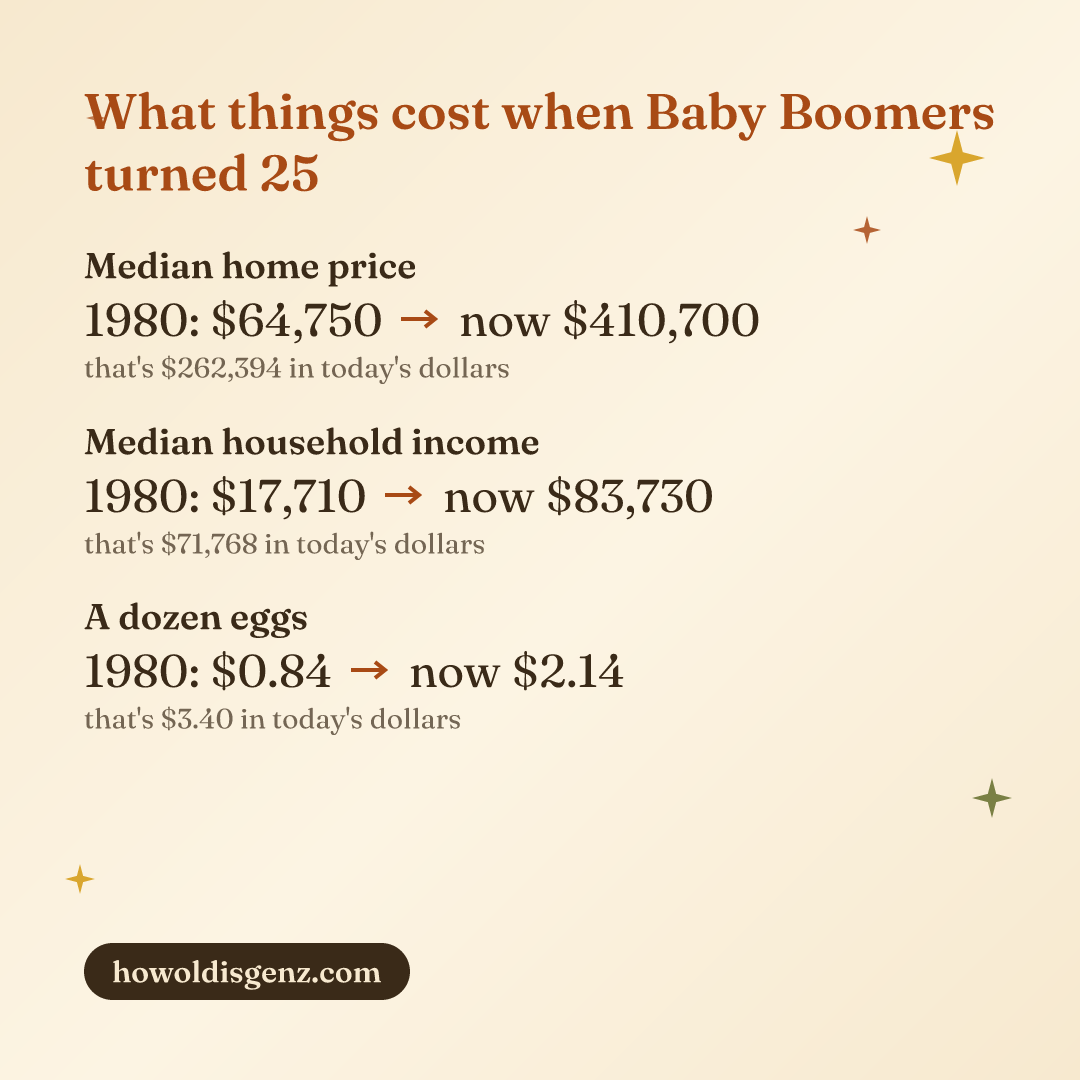
The median Boomer was born in 1955 and turned 25 in 1980 — straight into stagflation, with inflation over 13% and mortgage rates in the double digits. The sticker prices below look quaint; the interest rates were not.
Median home price
▲ 57% in real terms since 1980
- 1980 annual average
- $64,750
- In today's dollars
- $262,394
- Q2 2026
- $410,700
Median sales price of houses sold in the US (Census/HUD via FRED).
Median household income
▲ 17% in real terms since 1980
- 1980
- $17,710
- In today's dollars
- $71,768
- 2024 (latest available)
- $83,730
US median household income (Census Bureau).
A dozen eggs
▼ 37% in real terms since 1980
- 1980 annual average
- $0.84
- In today's dollars
- $3.40
- June 2026
- $2.14
Grade A large eggs, US city average (BLS average price data).
A gallon of gas
▼ 17% in real terms since 1980
- 1980 annual average
- $1.25
- In today's dollars
- $5.07
- June 2026
- $4.20
Unleaded regular, US city average (BLS average price data).
A year of college tuition
▲ 199% in real terms since 1980
- 1980–81 school year
- $804
- In today's dollars
- $3,258
- 2022–23 (latest NCES year)
- $9,750
Average tuition and required fees, public four-year institutions (NCES); both figures from the same NCES series.
Inflation adjustment uses BLS CPI-U annual averages (latest published month: 2026-06). Sources for every figure are listed in the sources section below.
Frequently asked questions
What years are Baby Boomers?
Baby Boomers were born from 1946 to 1964 — the one generational range that is officially defined, because the US Census Bureau tracks the postwar birth surge itself.
How old are Baby Boomers in 2026?
In 2026, Baby Boomers are between 61 and 80 years old. The oldest, born in 1946, began turning 80 in 2026.
Why are they called Baby Boomers?
Because of the boom in babies: US births jumped from 2.8 million in 1945 to 3.4 million in 1946 and stayed elevated through 1964, producing about 76 million children.
Is 1964 a Boomer year or Gen X?
1964 is the last Baby Boomer birth year under the Census definition; Generation X begins in 1965. Cusp kids born in the early '60s often identify with Gen X culture anyway.
What generation comes after Baby Boomers?
Generation X, born 1965–1980. Before the Boomers came the Silent Generation, born 1928–1945.
Are Boomers still the biggest generation?
Not anymore. Millennials passed them years ago — Boomers now number about 64 million (19% of the US population) to Millennials' roughly 74 million.
When do the youngest Boomers retire?
The youngest Boomers, born in 1964, turn 62 in 2026 and reach Social Security's full retirement age of 67 in 2031.
Share the answer
Settle the group-chat argument. The stat cards are ready-made for stories and posts.
Download a stat card
Sources
Every fact on this page is verified against the sources below; each entry in the underlying data file carries per-fact source references.
- The Baby Boom Cohort in the United States: 2012 to 2060 (P25-1141) — US Census Bureau
- Where Millennials end and Generation Z begins — Pew Research Center
- The oldest Baby Boomers turn 80 in 2026 — Pew Research Center
- How Every Generation of the Last Century Got Its Nickname — TIME
- US population by generation — Statista
- Baby boomers — Wikipedia
- Strauss-Howe Generational Theory — CDAMM
- Oprah Winfrey — Wikipedia
- Oprah Winfrey — Encyclopaedia Britannica
- Steve Jobs — Wikipedia
- Steve Jobs — Encyclopaedia Britannica
- Bill Gates — Wikipedia
- Bill Gates — Encyclopaedia Britannica
- Michael Jordan — Wikipedia
- Michael Jordan — Encyclopaedia Britannica
- Madonna — Wikipedia
- Madonna — Encyclopaedia Britannica
- Michael Jackson — Wikipedia
- Michael Jackson — Encyclopaedia Britannica
- Barack Obama — Wikipedia
- Barack Obama — Encyclopaedia Britannica
- Meryl Streep — Wikipedia
- Meryl Streep — Encyclopaedia Britannica
- Tom Hanks — Wikipedia
- Tom Hanks — Encyclopaedia Britannica
- The Graduate — Wikipedia
- The Graduate — Encyclopaedia Britannica
- Easy Rider — Wikipedia
- Easy Rider — Encyclopaedia Britannica
- Jaws (film) — Wikipedia
- Jaws — Encyclopaedia Britannica
- Star Wars (film) — Wikipedia
- Star Wars — Encyclopaedia Britannica
- Leave It to Beaver — Wikipedia
- Leave It to Beaver — Encyclopaedia Britannica
- The Ed Sullivan Show — Wikipedia
- Saturday Night Live — Wikipedia
- Saturday Night Live — Encyclopaedia Britannica
- The Beatles — Encyclopaedia Britannica
- Motown — Wikipedia
- Motown — Encyclopaedia Britannica
- Woodstock — Wikipedia
- Woodstock — Encyclopaedia Britannica
- The Catcher in the Rye — Wikipedia
- The Catcher in the Rye — Encyclopaedia Britannica
- On the Road — Wikipedia
- Jack Kerouac — Encyclopaedia Britannica
- To Kill a Mockingbird — Wikipedia
- To Kill a Mockingbird — Encyclopaedia Britannica
- Duck and cover — Wikipedia
- Draft lottery (1969) — Wikipedia
- Selective Service System — Encyclopaedia Britannica
- Regency TR-1 — Wikipedia
- Regency TR-1 transistor radio — Smithsonian / National Museum of American History
- Hula hoop — Wikipedia
- Hula hoop — Encyclopaedia Britannica
- Davy Crockett (miniseries) — Wikipedia
- Davy Crockett — Encyclopaedia Britannica
- Sputnik — Encyclopaedia Britannica
- Sputnik 1 — Wikipedia
- Cuban missile crisis — Encyclopaedia Britannica
- Cuban Missile Crisis — Wikipedia
- Assassination of John F. Kennedy — Encyclopaedia Britannica
- Assassination of John F. Kennedy — Wikipedia
- Civil Rights Act of 1964 — Encyclopaedia Britannica
- Civil Rights Act of 1964 — Wikipedia
- Apollo 11 — Encyclopaedia Britannica
- Apollo 11 — Wikipedia
- Kent State shootings — Encyclopaedia Britannica
- Kent State shootings — Wikipedia
- Vietnam War — Encyclopaedia Britannica
- Vietnam War — Wikipedia
- Watergate scandal — Encyclopaedia Britannica
- Watergate scandal — Wikipedia
- Median Sales Price of Houses Sold for the United States (MSPUS) — Census/HUD via FRED, St. Louis Fed
- Money Income of Households, Families, and Persons in the United States: 1980 (P60-132) — US Census Bureau
- Income, Poverty and Health Insurance Coverage in the United States: 2024 — US Census Bureau
- Average Price: Eggs, Grade A, Large (APU0000708111) — BLS via FRED, St. Louis Fed
- Average Price: Gasoline, Unleaded Regular (APU000074714) — BLS via FRED, St. Louis Fed
- Average undergraduate tuition and fees (Table 330.10) — National Center for Education Statistics