The Greatest Generation Born 1901–1927
How old is the Greatest Generation?
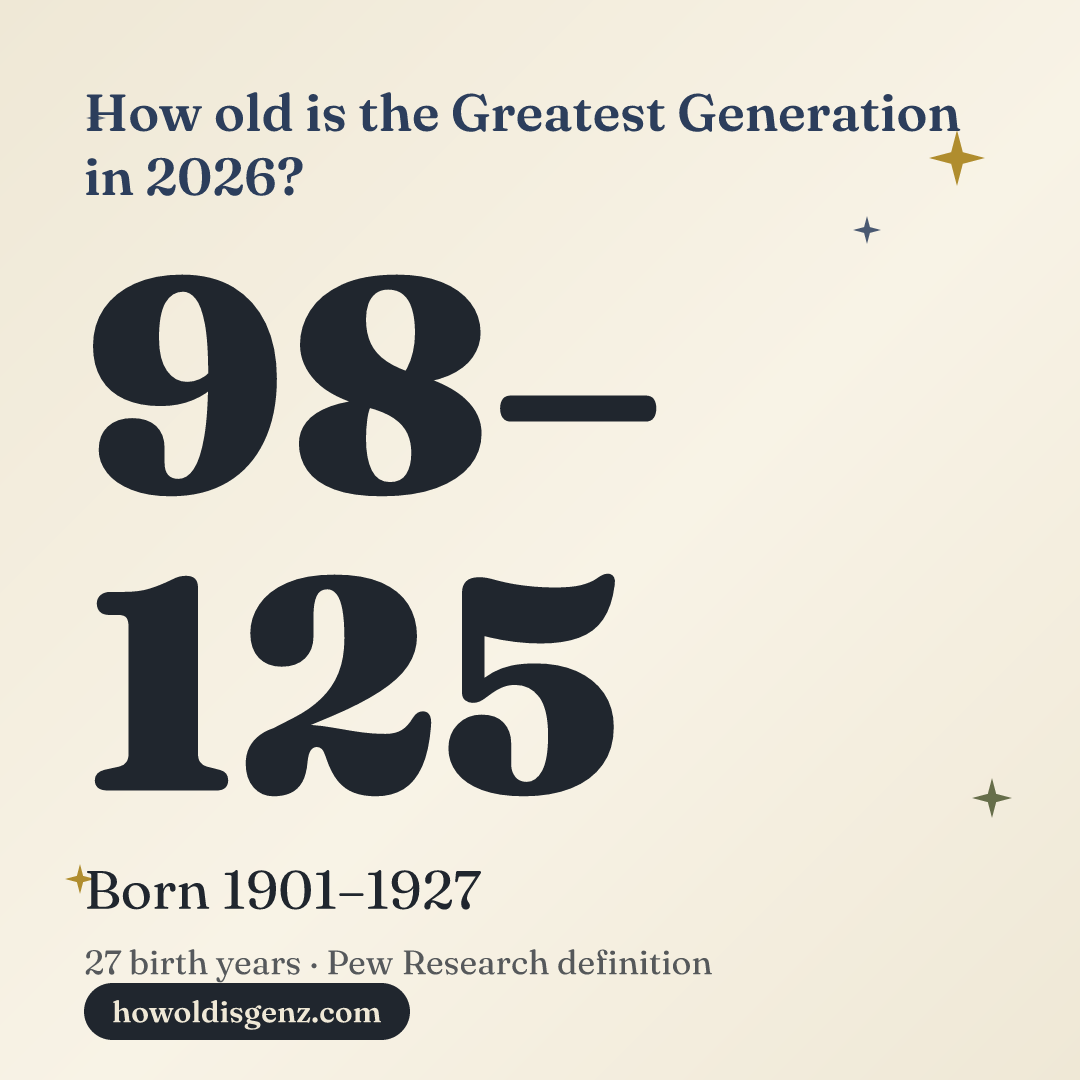
The Greatest Generation was born from 1901 to 1927, which means its members are currently aged between 98 and 125.
Ages current as of September 23, 2026 · The commonly used range: old enough to remember the Depression, young enough to fight in WWII.
The Greatest Generation was born into the age of the horse and buggy and lived to see the internet. They grew up in the Great Depression, fought and won World War II — some 16 million Americans served — then came home, cashed the GI Bill into degrees and suburbs, and built the postwar world every later generation grew up inside.
Quick facts
- Birth years
- 1901–1927
- Ages in 2026
- 98 to 125 years old
- Generation before
- The Lost Generation (1883–1900)
- Generation after
- The Silent Generation (1928–1945)
- Where the name comes from
- US Army General James Van Fleet used the phrase in 1953, but it was NBC anchor Tom Brokaw's 1998 bestseller The Greatest Generation that fixed the name: profiling the Americans who endured the Depression and won World War II, he wrote, 'It is, I believe, the greatest generation any society has ever produced.'
- Also known as
- the G.I. Generation · the WWII generation
Famous members of the Greatest Generation
Every one of them born between 1901 and 1927.
-
Louis Armstrong
b. 1901Music
Jazz's founding genius, from New Orleans to the world
-
Walt Disney
b. 1901Business
Built the mouse, the studio, and the kingdom
-
Grace Hopper
b. 1906Tech
Navy admiral who pioneered computer programming and COBOL
-
Rosa Parks
b. 1913Activism
Her refusal to move sparked the Montgomery bus boycott
-
Frank Sinatra
b. 1915Music
The Voice of the American century
-
John F. Kennedy
b. 1917Politics
PT-boat veteran turned 35th president
-
Ella Fitzgerald
b. 1917Music
The First Lady of Song
-
Jackie Robinson
b. 1919Sport
Broke baseball's color line in 1947
-
Marilyn Monroe
b. 1926Film & TV
Hollywood's most enduring icon, born at the generation's tail
The culture that raised them
Movies
- The Jazz Singer 1927 The first talkie — movies learned to speak as the youngest of them were born
- Gone with the Wind 1939 The Depression era's biggest escape, still the top-grossing film adjusted for inflation
- It's a Wonderful Life 1946 Capra's homecoming fable for a generation just back from war
TV
- FDR's fireside chats 1933 The president in the living room — radio made national intimacy possible
- The War of the Worlds broadcast 1938 Orson Welles' Halloween drama showed how completely radio held the country
Music
- Swing and Benny Goodman 1935 Big-band swing was their rock and roll; the Palomar Ballroom its big bang
- 'In the Mood' — Glenn Miller 1939 The wartime dance floor, distilled to three minutes
- 'White Christmas' — Bing Crosby 1942 Recorded mid-war; still the best-selling single of all time
Books
- The Great Gatsby 1925 The Jazz Age glittering just before the lights went out
- The Grapes of Wrath 1939 Their Depression, in hardcover
- Action Comics #1 (Superman) 1938 The superhero was invented for — and by — this generation
You probably didn't know
The non-obvious markers — the stuff only the Greatest Generation remembers.
-
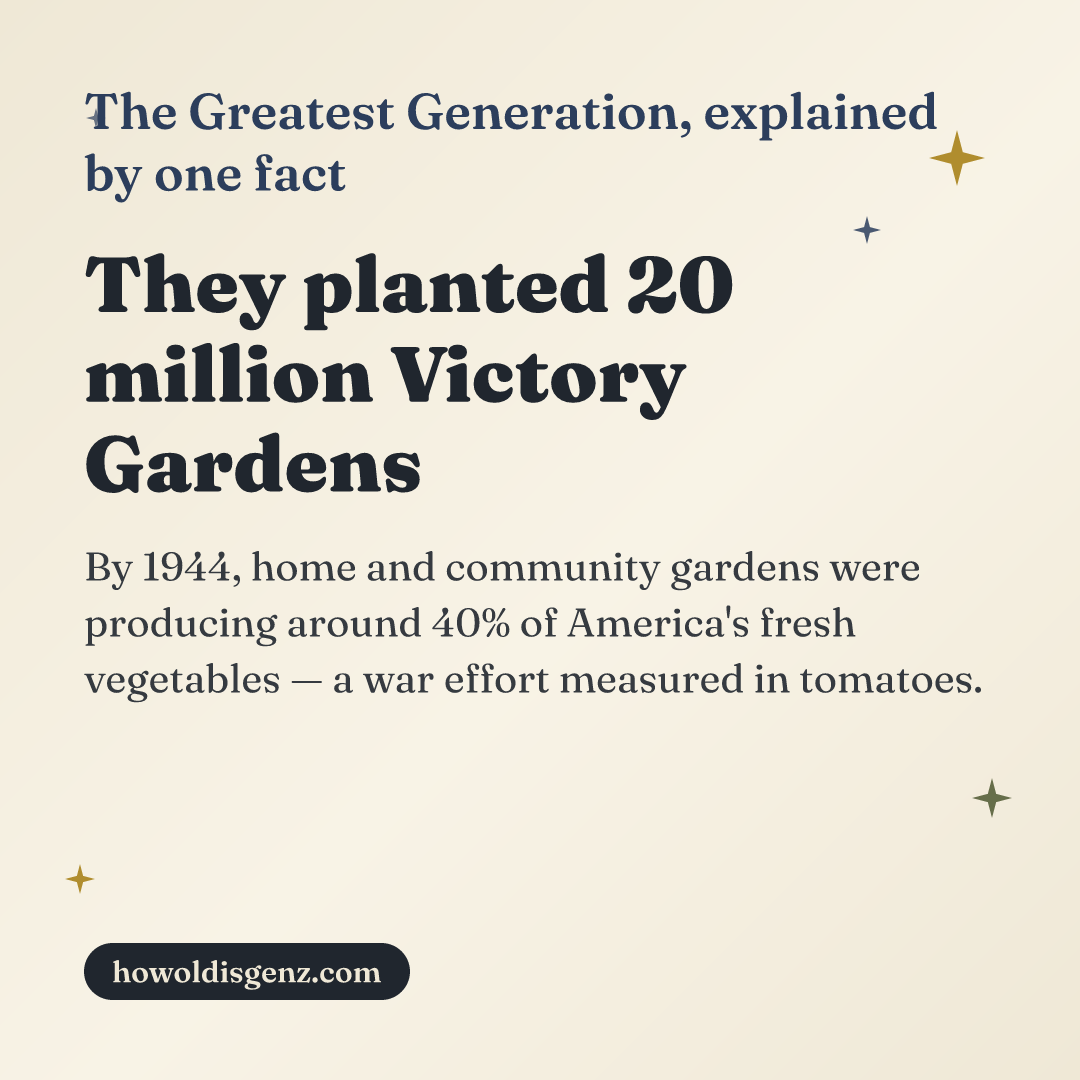
They planted 20 million Victory Gardens
By 1944, home and community gardens were producing around 40% of America's fresh vegetables — a war effort measured in tomatoes.
-
Three million young men joined the CCC
The Civilian Conservation Corps (1933–1942) paid Depression-era youths $30 a month — $25 of it sent home — to plant forests and build the state parks still in use.
-
'Kilroy was here' went everywhere they did
The long-nosed doodle peeking over a wall was the GI's universal calling card, scrawled from Normandy to Okinawa.
-
The GI Bill remade the country
The 1944 Servicemen's Readjustment Act sent nearly 8 million veterans to school or training and underwrote the mortgages that built the suburbs their Boomer kids grew up in.
-
A movie ticket cost about a quarter
Depression-era admission commonly ran 25 cents or less for a double feature with a newsreel — the cheapest escape in America.
The events that shaped the Greatest Generation
-
Influenza pandemic
The flu killed about 675,000 Americans while the oldest of the generation were in grade school.
-
The Crash and the Depression
The formative catastrophe: unemployment near 25% shaped a lifetime of frugality.
-
The New Deal
FDR's programs put the generation's young men to work and rewired Americans' relationship with government.
-
Pearl Harbor
December 7, 1941: the attack that sent 16 million Americans — the heart of this generation — into uniform.
-
D-Day
June 6, 1944: the largest amphibious invasion in history, carried out by the generation's 18-to-40-year-olds.
-
Victory — and the atomic age
The war ended in 1945; the bomb that ended it opened the era their children would duck-and-cover through.
-
The GI Bill
Education, loans, and mortgages for veterans — the quiet law behind the postwar middle class.
What things cost when the Greatest Generation turned 25
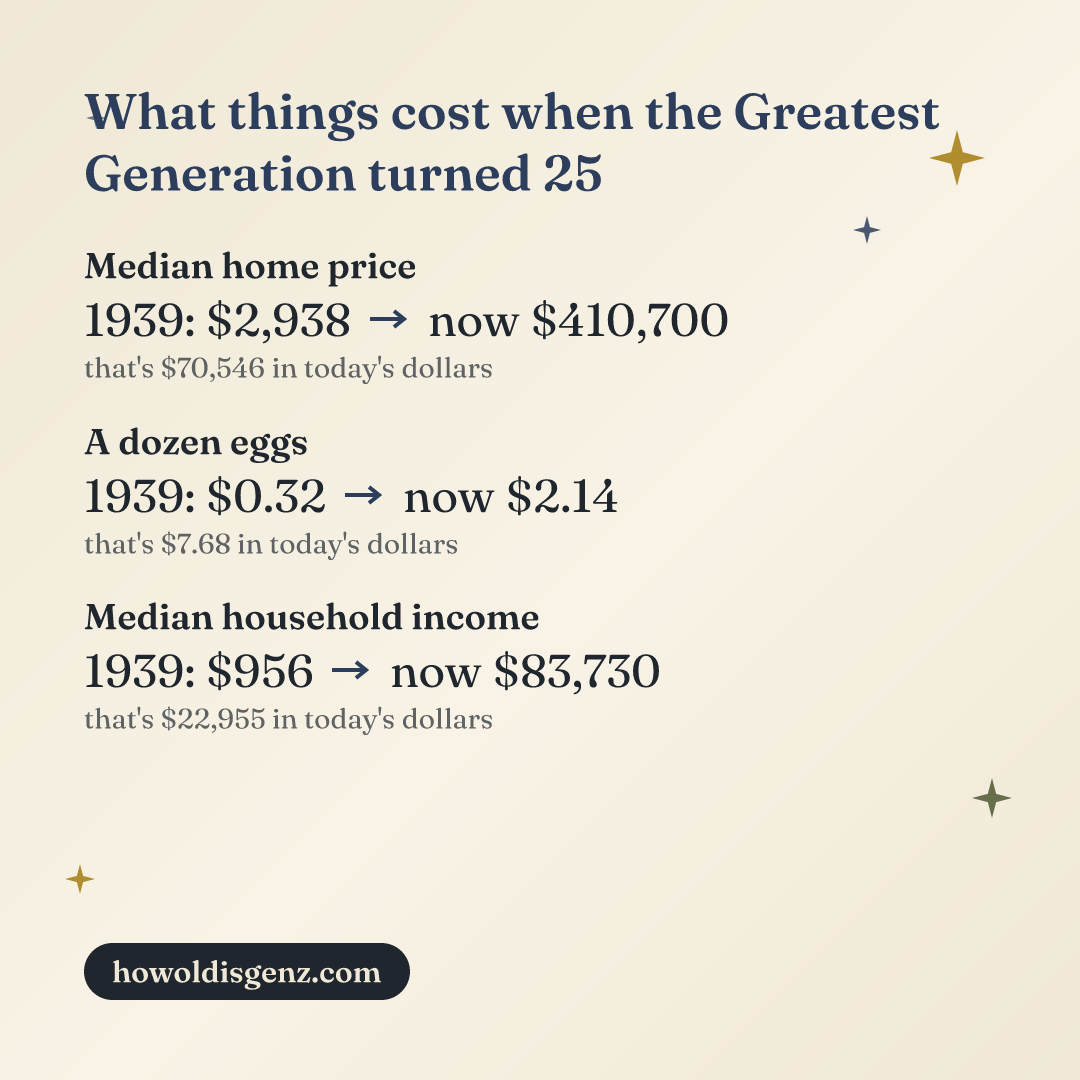
The median member was born in 1914 and turned 25 in 1939 — the tail of the Depression, with the war two years away. Systematic national price statistics were thinner then; the verified figures below come from the 1940 Census, BLS retail food price records, and EIA gasoline price history.
Median home price
▲ 482% in real terms since 1939
- 1940 (median home value, decennial census)
- $2,938
- In today's dollars
- $70,546
- Q2 2026
- $410,700
1940 figure is the median value of owner-occupied homes from the decennial census — the earliest national benchmark.
A dozen eggs
▼ 72% in real terms since 1939
- 1939
- $0.32
- In today's dollars
- $7.68
- June 2026
- $2.14
BLS-derived retail averages compiled by secondary sources.
Median household income
▲ 265% in real terms since 1939
- 1939 (median male wage income, 1940 census)
- $956
- In today's dollars
- $22,955
- 2024
- $83,730
Median wage or salary income of men in 1939, from the 1940 census — the first US census to ask about income. The median for women was $592.
A gallon of gas
▼ 8% in real terms since 1939
- 1939
- $0.19
- In today's dollars
- $4.56
- June 2026
- $4.20
EIA historical average including taxes, matching the tax treatment of the modern BLS series. The API 50-city pump price excluding taxes averaged 13.3 cents (Minerals Yearbook 1940).
Inflation adjustment uses BLS CPI-U annual averages (latest published month: 2026-06). Sources for every figure are listed in the sources section below.
Frequently asked questions
What years are the Greatest Generation?
The Greatest Generation was born roughly 1901 to 1927 — old enough to remember the Depression, young enough to fight in World War II. Strauss & Howe, who call them the G.I. Generation, use 1901–1924.
How old is the Greatest Generation in 2026?
Surviving members are between 98 and 125 years old in 2026 — all centenarians or nearly so.
Why are they called the Greatest Generation?
Tom Brokaw's 1998 book of that name made the label universal — 'the greatest generation any society has ever produced' — honoring the cohort that endured the Depression and won WWII. Army General James Van Fleet had used the phrase as early as 1953.
Did the whole generation fight in World War II?
About 16 million Americans served in WWII, the overwhelming majority from this generation — and those on the home front worked the factories and farms that supplied the war.
What generation came before and after?
Before them: the Lost Generation, born roughly 1883–1900, who fought WWI. After them: the Silent Generation, born 1928–1945, who were children during WWII.
Is anyone from the Greatest Generation still alive?
Yes, though few: the youngest members turn 99 in 2026. WWII veterans in particular are now a fast-dwindling group of centenarians.
Share the answer
Settle the group-chat argument. The stat cards are ready-made for stories and posts.
Download a stat card
Sources
Every fact on this page is verified against the sources below; each entry in the underlying data file carries per-fact source references.
- Greatest Generation — Encyclopaedia Britannica
- Greatest Generation — Wikipedia
- The Greatest Generation (book) — Wikipedia
- Strauss-Howe Generational Theory — CDAMM
- Where Millennials end and Generation Z begins — Pew Research Center
- WWII Veteran Statistics — The National WWII Museum
- Louis Armstrong — Wikipedia
- Louis Armstrong — Encyclopaedia Britannica
- Walt Disney — Wikipedia
- Walt Disney — Encyclopaedia Britannica
- Grace Hopper — Wikipedia
- Grace Hopper — Encyclopaedia Britannica
- Rosa Parks — Wikipedia
- Rosa Parks — Encyclopaedia Britannica
- Frank Sinatra — Wikipedia
- Frank Sinatra — Encyclopaedia Britannica
- John F. Kennedy — Wikipedia
- John F. Kennedy — Encyclopaedia Britannica
- Ella Fitzgerald — Wikipedia
- Ella Fitzgerald — Encyclopaedia Britannica
- Jackie Robinson — Wikipedia
- Jackie Robinson — Encyclopaedia Britannica
- Marilyn Monroe — Wikipedia
- Marilyn Monroe — Encyclopaedia Britannica
- The Jazz Singer — Wikipedia
- The Jazz Singer — Encyclopaedia Britannica
- Gone with the Wind (film) — Wikipedia
- Gone with the Wind — Encyclopaedia Britannica
- It's a Wonderful Life — Wikipedia
- Frank Capra — Encyclopaedia Britannica
- Fireside chats — Wikipedia
- Franklin D. Roosevelt — Encyclopaedia Britannica
- The War of the Worlds (1938 radio drama) — Wikipedia
- Orson Welles — Encyclopaedia Britannica
- Benny Goodman — Wikipedia
- Benny Goodman — Encyclopaedia Britannica
- In the Mood — Wikipedia
- Glenn Miller — Encyclopaedia Britannica
- White Christmas (song) — Wikipedia
- Best-selling single — Guinness World Records
- The Great Gatsby — Wikipedia
- The Great Gatsby — Encyclopaedia Britannica
- The Grapes of Wrath — Wikipedia
- John Steinbeck — Encyclopaedia Britannica
- Action Comics 1 — Wikipedia
- Superman — Encyclopaedia Britannica
- Victory garden — Wikipedia
- Victory Gardens — Smithsonian Gardens
- Civilian Conservation Corps — Wikipedia
- Civilian Conservation Corps — Encyclopaedia Britannica
- Kilroy was here — Wikipedia
- Kilroy Was Here — Smithsonian Magazine
- G.I. Bill — Wikipedia
- G.I. Bill — Encyclopaedia Britannica
- Double feature — Wikipedia
- History of film: The Hollywood studio system — Encyclopaedia Britannica
- 1918 Pandemic (H1N1 virus) — CDC
- Influenza pandemic of 1918–19 — Encyclopaedia Britannica
- Stock market crash of 1929 — Encyclopaedia Britannica
- Great Depression in the United States — Wikipedia
- New Deal — Encyclopaedia Britannica
- New Deal — Wikipedia
- Pearl Harbor attack — Encyclopaedia Britannica
- Attack on Pearl Harbor — Wikipedia
- Normandy Invasion — Encyclopaedia Britannica
- Normandy landings — Wikipedia
- World War II — Encyclopaedia Britannica
- Victory over Japan Day — Wikipedia
- Historical Census of Housing Tables: Home Values — US Census Bureau
- How much housing prices have risen since 1940 — CNBC
- How Much A Dozen Eggs Cost The Year You Were Born — The Daily Meal
- A Look Back at What Things Used to Cost — Farmers' Almanac
- Family Wage or Salary Income in 1939 (1940 Census) — US Census Bureau
- Average Price: Gasoline, Unleaded Regular (APU000074714) — BLS via FRED, St. Louis Fed
- 'It's Your America:' The 1940 Census Today — The National WWII Museum
- Inflation Adjusted Gasoline Prices (EIA data) — InflationData.com, from US Energy Information Administration
- Minerals Yearbook 1940 — gasoline prices — US Bureau of Mines