The Lost Generation Born 1883–1900
How old is the Lost Generation?
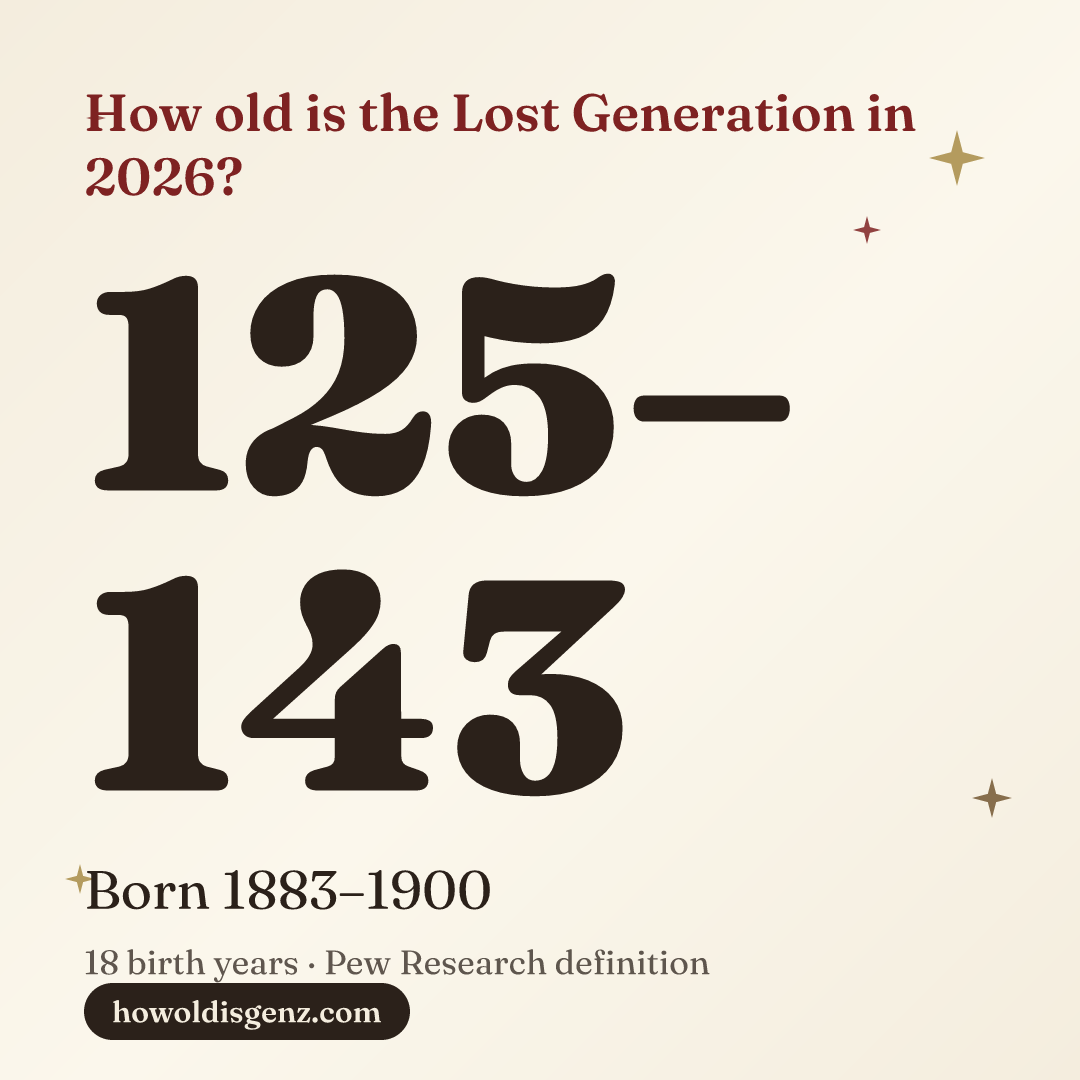
The Lost Generation was born from 1883 to 1900, which means its members are currently aged between 125 and 143.
Ages current as of September 23, 2026 · The commonly used range for the cohort that came of age during World War I; exact endpoints are approximate.
The Lost Generation was born into a world of gaslight and horse carts and came of age in the mechanized slaughter of World War I. The survivors — disillusioned with the pieties that had sent them to the trenches — wrote the books, played the jazz, and threw the parties that defined the Roaring Twenties. They are the oldest cohort that generational charts bother to name.
Quick facts
- Birth years
- 1883–1900
- Ages in 2026
- 125 to 143 years old
- Generation after
- The Greatest Generation (1901–1927)
- Where the name comes from
- A Paris garage owner, scolding a young mechanic, snapped that the war's survivors were all 'une génération perdue' — a lost generation. Gertrude Stein passed the line to Ernest Hemingway ('You are all a lost generation'), and Hemingway made it immortal as the epigraph of The Sun Also Rises in 1926.
- Also known as
- the WWI generation · the Generation of 1914
Famous members of the Lost Generation
Every one of them born between 1883 and 1900.
-
Eleanor Roosevelt
b. 1884Politics
First Lady, then first chair of the UN Human Rights Commission
-
Georgia O'Keeffe
b. 1887Art & design
The mother of American modernism
-
Charlie Chaplin
b. 1889Film & TV
The Tramp — cinema's first global superstar
-
Dwight D. Eisenhower
b. 1890Politics
Supreme Allied Commander, then 34th president
-
Babe Ruth
b. 1895Sport
The Sultan of Swat invented sports celebrity
-
F. Scott Fitzgerald
b. 1896Literature
Chronicler-in-chief of the Jazz Age
-
Amelia Earhart
b. 1897Science
First woman to fly the Atlantic solo
-
Duke Ellington
b. 1899Music
Half a century of American music, composed nightly
-
Ernest Hemingway
b. 1899Literature
Ambulance driver at 18; the generation's defining voice
The culture that raised them
Movies
- The Kid 1921 Chaplin's Tramp adopts an orphan; the movies learn to break hearts
- Nosferatu 1922 Silent horror at its most enduring
- The Jazz Singer 1927 Sound arrives — the medium they grew up with becomes the one we know
Music
- 'Livery Stable Blues' 1917 The Original Dixieland Jass Band cut the first jazz record; the age got its soundtrack
- 'Alexander's Ragtime Band' — Irving Berlin 1911 Ragtime crossed over, and American popular music was born
- The Cotton Club era 1927 Duke Ellington's residency broadcast the Harlem Renaissance to the nation
Books
- The Sun Also Rises 1926 Hemingway's expat novel carried the generation's name in its epigraph
- The Great Gatsby 1925 Fitzgerald's green light — the era's self-portrait
- The Waste Land 1922 T.S. Eliot's fractured epic of postwar disillusion
You probably didn't know
The non-obvious markers — the stuff only the Lost Generation remembers.
-
The name began as a garage owner's insult
'Une génération perdue' was first aimed at a slow young mechanic in France. Stein repeated it to Hemingway; Hemingway put it in print; the insult became an identity.
-
A new Model T cost $440 in 1916
Ford's assembly line kept cutting the Touring model's price — by the 1920s it fell under $300, and the Lost Generation became the first cohort to grow up with cars.
-
The 1918 flu was deadlier to them than the war
The influenza pandemic killed about 675,000 Americans — several times US combat deaths in WWI — and it hit young adults hardest, this generation exactly.
-
Their twenties were legally dry
Prohibition (1920–1933) landed just as the youngest of them hit drinking age — so the generation that wrote the best bar scenes in American literature did its drinking in speakeasies and Paris.
-
Radio arrived in their middle age
KDKA in Pittsburgh made the first commercial broadcast in November 1920 — mass media as we know it began after they were grown.
The events that shaped the Lost Generation
-
The Model T
Ford's car for the multitude started replacing the horse while the generation was in school.
-
World War I begins
The July crisis detonated the war that would define — and name — the generation.
-
America enters the war
About 4.7 million Americans served; over 116,000 never came home.
-
Influenza pandemic
The deadliest pandemic of the modern era struck the same young adults the war had spared.
-
Suffrage and Prohibition
The 19th Amendment gave women the vote the same year the 18th shut the bars — both reshaping the generation's adult world.
-
Lindbergh crosses the Atlantic
The Spirit of St. Louis made a 25-year-old the most famous man alive and aviation the future.
-
The Crash
The party the survivors had thrown through the '20s ended in October 1929, with the generation entering middle age.
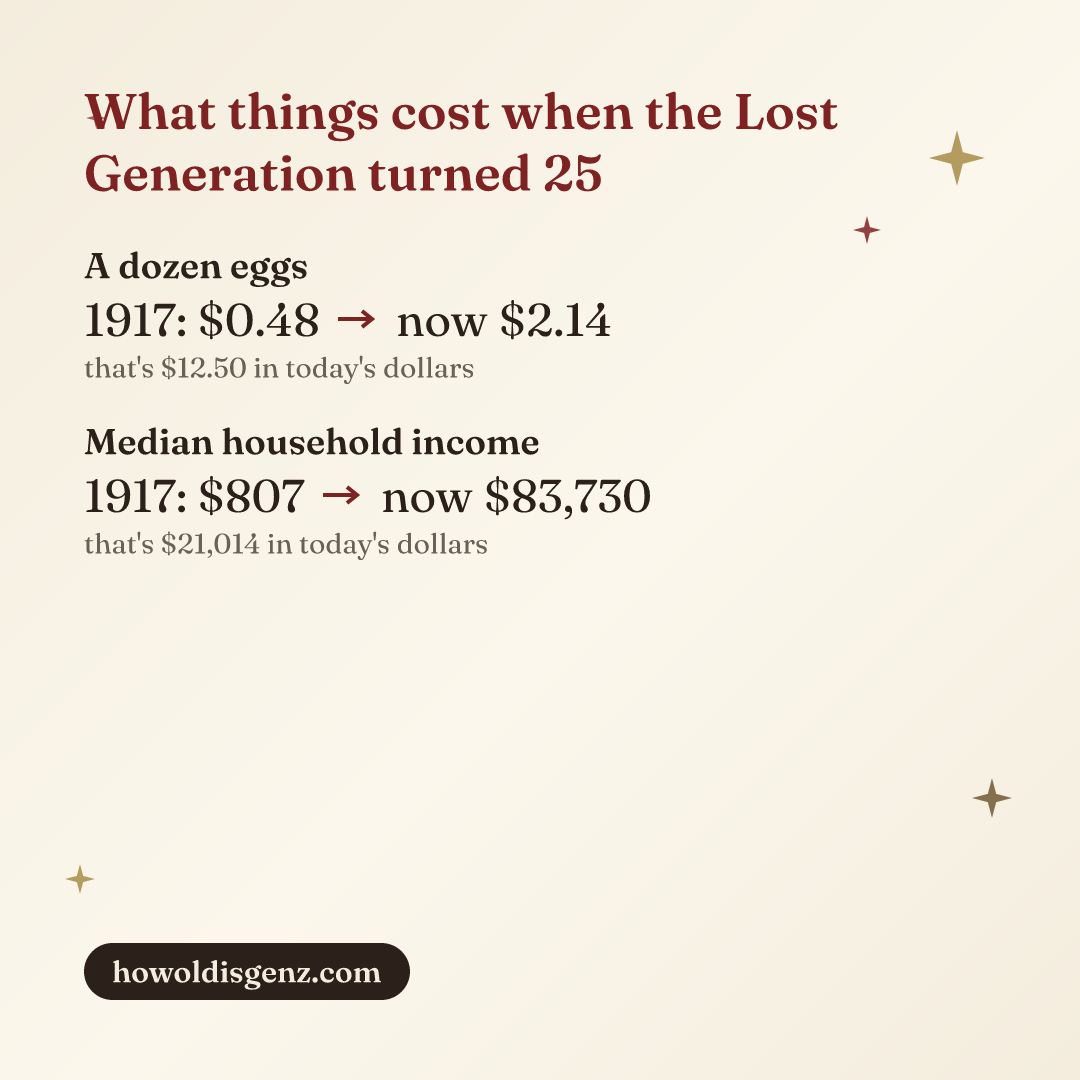
What things cost when the Lost Generation turned 25
The median member was born around 1892 and turned 25 in 1917 — the year America entered WWI. National statistics from that era are scarcer than for later generations; the figures below come from federal historical compilations, cited in the sources.
A dozen eggs
▼ 83% in real terms since 1917
- 1917
- $0.48
- In today's dollars
- $12.50
- June 2026
- $2.14
US average retail price of strictly fresh eggs, 48.1 cents per dozen — BLS Bulletin 300, reproduced as series E 194 in Historical Statistics of the United States.
Median household income
▲ 298% in real terms since 1917
- 1917 (average annual earnings when employed)
- $807
- In today's dollars
- $21,014
- 2024
- $83,730
Average annual earnings of all employees when employed (Historical Statistics series D 722–727, Lebergott); $748 after allowing for unemployment. Lebergott's 1984 revision puts nonfarm earnings at $866.
Inflation adjustment uses BLS CPI-U annual averages (latest published month: 2026-06). Sources for every figure are listed in the sources section below.
Frequently asked questions
What years are the Lost Generation?
The Lost Generation was born roughly 1883 to 1900 — the cohort that reached young adulthood during World War I. The endpoints are approximate; formal generational bookkeeping didn't exist yet.
Is anyone from the Lost Generation still alive?
No. The youngest members, born in 1900, would be 125 in 2026; the world's last verified people born in the 1800s died in the late 2010s.
Why are they called the Lost Generation?
A Paris garage owner coined it as an insult about postwar youth; Gertrude Stein repeated it to Hemingway — 'You are all a lost generation' — and Hemingway used it as the epigraph of The Sun Also Rises (1926). 'Lost' meant disoriented and disillusioned, not missing.
Who were the famous Lost Generation writers?
The Paris expatriate circle: Hemingway, F. Scott Fitzgerald, John Dos Passos, E.E. Cummings, and T.S. Eliot among them, with Gertrude Stein as den mother. But the generation also produced Eisenhower, Chaplin, Babe Ruth, and Duke Ellington.
What war did the Lost Generation fight in?
World War I. About 4.7 million Americans served in 1917–1918, drawn almost entirely from this generation.
What generation came after the Lost Generation?
The Greatest Generation, born roughly 1901–1927 — their younger siblings and children, who fought World War II.
Share the answer
Settle the group-chat argument. The stat cards are ready-made for stories and posts.
Download a stat card
Sources
Every fact on this page is verified against the sources below; each entry in the underlying data file carries per-fact source references.
- Lost Generation — Wikipedia
- Lost Generation — Encyclopaedia Britannica
- The Lost Generation: Who They Are and Why They're 'Lost' — FamilySearch
- Quote Origin: You Are All a Lost Generation — Quote Investigator
- Greatest Generation — Wikipedia
- Greatest Generation — Encyclopaedia Britannica
- Eleanor Roosevelt — Wikipedia
- Eleanor Roosevelt — Encyclopaedia Britannica
- Georgia O'Keeffe — Wikipedia
- Georgia O'Keeffe — Encyclopaedia Britannica
- Charlie Chaplin — Wikipedia
- Charlie Chaplin — Encyclopaedia Britannica
- Dwight D. Eisenhower — Wikipedia
- Dwight D. Eisenhower — Encyclopaedia Britannica
- Babe Ruth — Wikipedia
- Babe Ruth — Encyclopaedia Britannica
- F. Scott Fitzgerald — Wikipedia
- F. Scott Fitzgerald — Encyclopaedia Britannica
- Amelia Earhart — Wikipedia
- Amelia Earhart — Encyclopaedia Britannica
- Duke Ellington — Wikipedia
- Duke Ellington — Encyclopaedia Britannica
- Ernest Hemingway — Wikipedia
- Ernest Hemingway — Encyclopaedia Britannica
- The Kid (1921 film) — Wikipedia
- Nosferatu — Wikipedia
- Nosferatu — Encyclopaedia Britannica
- The Jazz Singer — Wikipedia
- The Jazz Singer — Encyclopaedia Britannica
- Livery Stable Blues — Wikipedia
- Jazz — Encyclopaedia Britannica
- Alexander's Ragtime Band — Wikipedia
- Irving Berlin — Encyclopaedia Britannica
- Cotton Club — Wikipedia
- The Sun Also Rises — Wikipedia
- The Great Gatsby — Wikipedia
- The Great Gatsby — Encyclopaedia Britannica
- The Waste Land — Wikipedia
- T.S. Eliot — Encyclopaedia Britannica
- 1916 — Model T Encyclopedia — Model T Ford Club of America
- 1916 Ford Model T Touring — Classic.com
- 1918 Pandemic (H1N1 virus) — CDC
- Influenza pandemic of 1918–19 — Encyclopaedia Britannica
- Prohibition in the United States — Wikipedia
- Prohibition — Encyclopaedia Britannica
- KDKA (AM) — Wikipedia
- Radio — Encyclopaedia Britannica
- Model T — Encyclopaedia Britannica
- Ford Model T — Wikipedia
- World War I — Encyclopaedia Britannica
- World War I — Wikipedia
- United States in World War I — Encyclopaedia Britannica
- United States in World War I — Wikipedia
- Nineteenth Amendment — Encyclopaedia Britannica
- Charles Lindbergh — Encyclopaedia Britannica
- Charles Lindbergh — Wikipedia
- Stock market crash of 1929 — Encyclopaedia Britannica
- Wall Street crash of 1929 — Wikipedia
- Average Price: Eggs, Grade A, Large (APU0000708111) — BLS via FRED, St. Louis Fed
- Retail Prices, 1913 to December 1920 (Bulletin No. 300, Table A) — US Bureau of Labor Statistics, via FRASER
- Historical Statistics of the United States, Colonial Times to 1970 — ch. E, series E 187–202 (retail food prices) — US Census Bureau
- Historical Statistics of the United States, Colonial Times to 1970 — ch. D, series D 722–727 (average annual earnings) — US Census Bureau
- Wages and Working Conditions (Table 1, citing Lebergott 1984) — Econlib, Concise Encyclopedia of Economics
- Income, Poverty and Health Insurance Coverage in the United States: 2024 — US Census Bureau