The Silent Generation Born 1928–1945
How old is the Silent Generation?
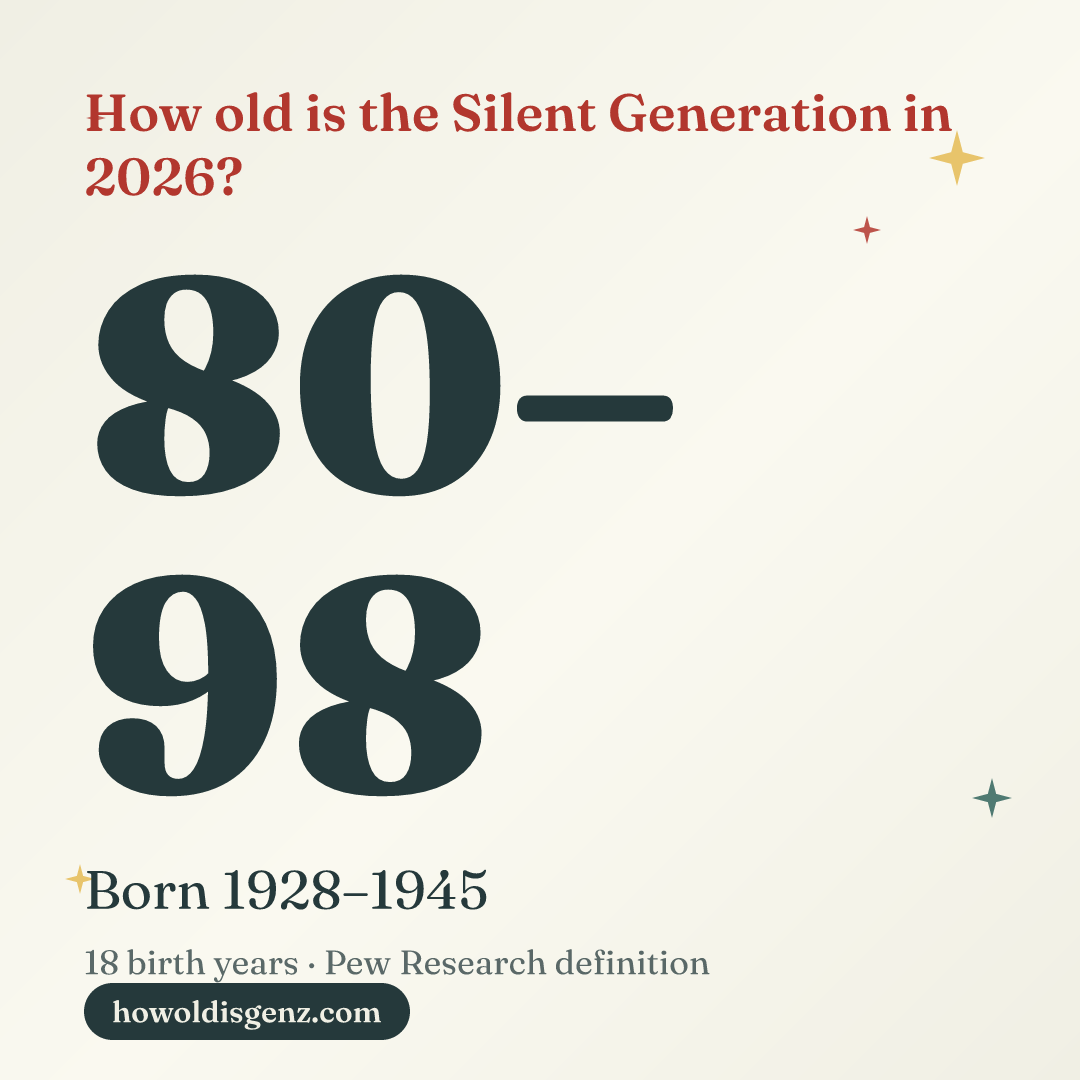
The Silent Generation was born from 1928 to 1945, which means its members are currently aged between 80 and 98.
Ages current as of September 23, 2026 · Pew Research Center definition: born during the Depression and WWII.
The Silent Generation was born into the Depression and World War II — too young to fight in it, old enough to remember rationing. They fought in Korea, invented rock and roll and led the civil rights movement (Martin Luther King Jr. was born in 1929), and turned out to be anything but silent. Demographers also call them 'the Lucky Few': a small cohort that came of age into the postwar boom.
Quick facts
- Birth years
- 1928–1945
- Ages in 2026
- 80 to 98 years old
- Generation before
- The Greatest Generation (1901–1927)
- Generation after
- Baby Boomers (1946–1964)
- US population
- ≈4% of Americans Roughly 13–14 million people in 2024 estimates; every member is now in their 80s or 90s.
- Where the name comes from
- TIME's November 5, 1951 essay 'The Younger Generation' described a cautious cohort that 'does not issue manifestoes, make speeches or carry posters' — by comparison with the flaming youth of their parents, 'a still, small flame.' The name stuck: the Silent Generation, shaped by the Depression and McCarthy-era caution.
- Also known as
- Silents · the Lucky Few · Builders
Famous members of the Silent Generation
Every one of them born between 1928 and 1945.
-
Martin Luther King Jr.
b. 1929Activism
Led the movement that remade American law and conscience
-
Elvis Presley
b. 1935Music
The King of Rock and Roll, scandalizing parents by 1956
-
Bob Dylan
b. 1941Music
Folk prophet; first songwriter to win the Nobel in Literature
-
Aretha Franklin
b. 1942Music
The Queen of Soul demanded R-E-S-P-E-C-T
-
Muhammad Ali
b. 1942Sport
Three-time heavyweight champion; conscience with a jab
-
Neil Armstrong
b. 1930Science
First human on the Moon, July 20, 1969
-
Ruth Bader Ginsburg
b. 1933Politics
Supreme Court justice and unlikely octogenarian icon
-
Warren Buffett
b. 1930Business
The Oracle of Omaha, investing since age 11
-
Jane Goodall
b. 1934Science
Redefined what we know about chimpanzees — and ourselves
The culture that raised them
Movies
- The Wizard of Oz 1939 Technicolor wonder for a childhood in black and white
- Casablanca 1942 The wartime romance playing as they came of age
- Singin' in the Rain 1952 Hollywood's golden age at its giddiest
- Rebel Without a Cause 1955 James Dean gave the quiet generation its restless icon
TV
- I Love Lucy 1951 The show that taught America to schedule its evenings
- Howdy Doody 1947 Children's TV was invented on their watch
- The Ed Sullivan Show 1948 Sunday night variety — where they saw Elvis from the waist up
Music
- Elvis on Ed Sullivan 1956 60 million viewers; the cameras famously kept it polite
- Frank Sinatra and the bobby-soxers 1944 The original screaming-teen fandom, at the Paramount Theatre
- 'That's All Right' — Elvis Presley 1954 Nineteen-year-old Elvis at Sun Studio: rock and roll's big bang
Books
- The Grapes of Wrath 1939 Steinbeck's Depression epic, published as they lived it
- 1984 — George Orwell 1949 Cold War dread in novel form
- The Catcher in the Rye 1951 Published the year TIME called them silent; Holden disagreed
You probably didn't know
The non-obvious markers — the stuff only the Silent Generation remembers.
-
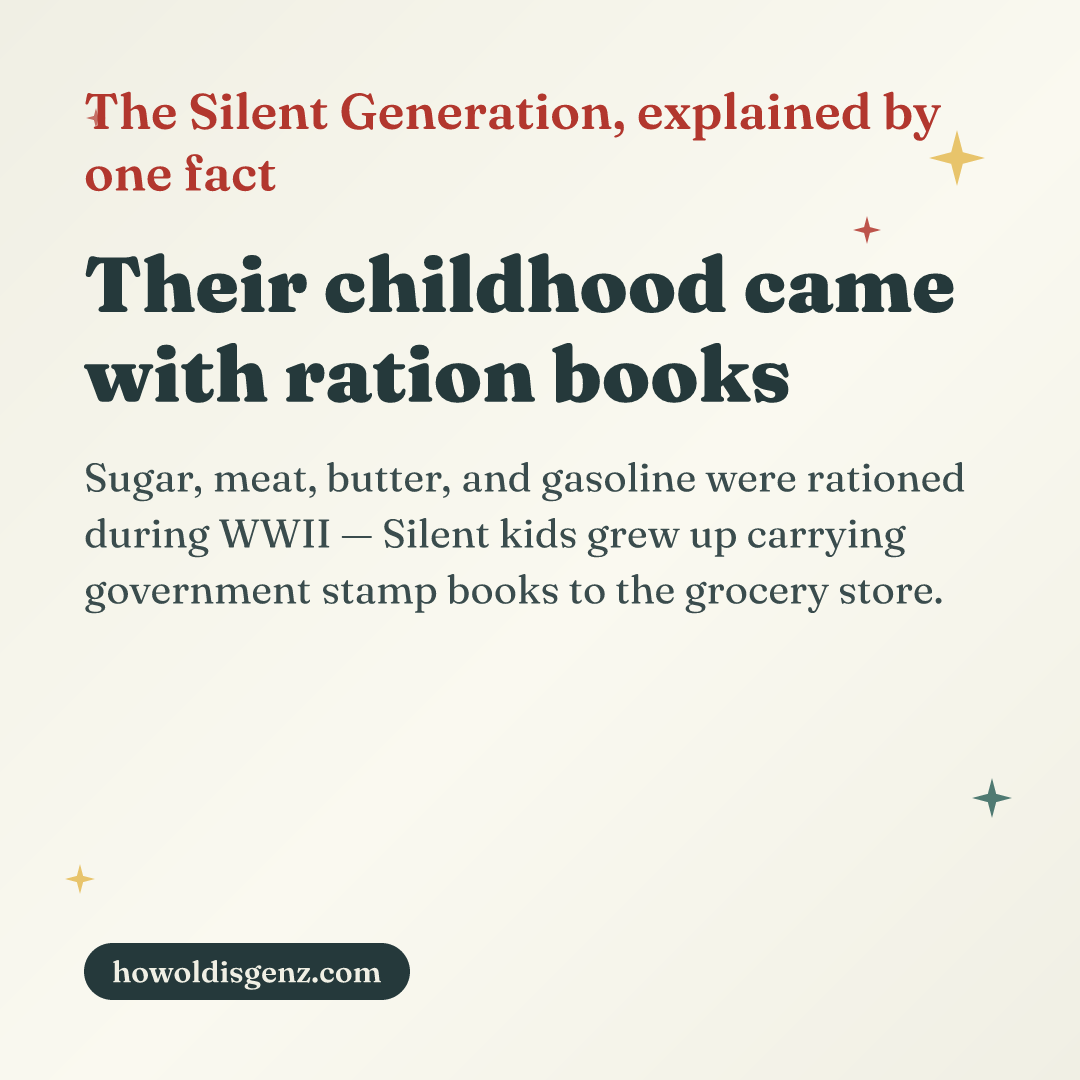
Their childhood came with ration books
Sugar, meat, butter, and gasoline were rationed during WWII — Silent kids grew up carrying government stamp books to the grocery store.
-
Summer meant polio panic
Pools and theaters closed during outbreak summers; the March of Dimes was a school ritual until Jonas Salk's vaccine arrived in 1955.
-
The 45 changed everything
RCA's 7-inch 45 rpm single, introduced in 1949, made records cheap enough for teenagers — and teen music economically inevitable.
-
Sock hops were literal
School dances were held in gymnasiums where street shoes would scuff the floor — so everyone danced in socks.
-
The drive-in was the place to be
Drive-in theaters peaked at more than 4,000 screens in the late 1950s — the Silent Generation's dating institution of choice.
-
They're 'the Lucky Few'
Demographer Elwood Carlson's name for them: a small Depression-era cohort that hit adulthood exactly as the postwar boom created more jobs than workers.
The events that shaped the Silent Generation
-
The Crash
The stock market collapsed the year after the first Silents were born; the Depression was their nursery.
-
Pearl Harbor
December 7, 1941 pulled America into WWII — Silent kids collected scrap metal and watched older brothers ship out.
-
WWII ends
V-J Day closed the war that framed their childhood, in the year the youngest Silents were born.
-
Korean War begins
The Silent Generation's war: about 1.8 million Americans served in Korea, most of them Silents.
-
Brown v. Board of Education
The Supreme Court struck down school segregation as young Silents were finishing school and starting the movement to enforce it.
-
Montgomery bus boycott
Rosa Parks' arrest sparked a 381-day boycott led by a 26-year-old Silent named Martin Luther King Jr.
-
Cuban Missile Crisis
The generation's young-adult years peaked in thirteen days of nuclear brinkmanship.
-
March on Washington
250,000 people heard King's 'I Have a Dream' — the Silent Generation's defining public moment, at its own hands.
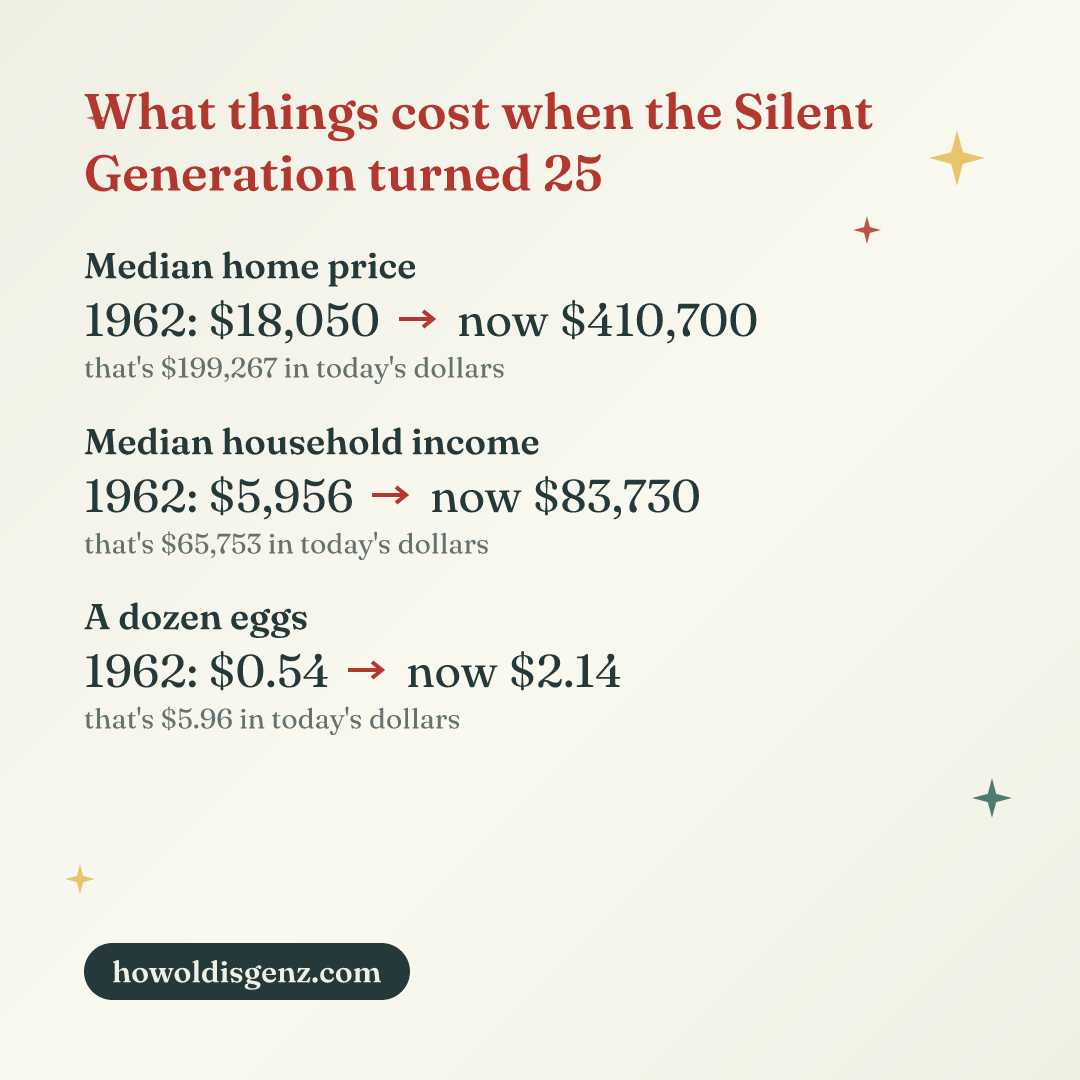
What things cost when the Silent Generation turned 25
The median Silent was born in 1937 and turned 25 in 1962 — early-'60s boom years when a factory wage could carry a mortgage. House and tuition figures below are from 1963, the earliest years in their federal series.
Median home price
▲ 106% in real terms since 1962
- 1963 annual average (earliest in series)
- $18,050
- In today's dollars
- $199,267
- Q2 2026
- $410,700
Median sales price of houses sold in the US (Census/HUD via FRED); the series begins in 1963.
Median household income
▲ 27% in real terms since 1962
- 1962 (median family income)
- $5,956
- In today's dollars
- $65,753
- 2024 (median household income)
- $83,730
1962 figure is median family income (Census P60-43) — the household series didn't exist yet.
A dozen eggs
▼ 64% in real terms since 1962
- 1962
- $0.54
- In today's dollars
- $5.96
- June 2026
- $2.14
BLS-derived retail averages compiled by secondary sources; the modern BLS series begins in 1980.
A gallon of gas
▲ 23% in real terms since 1962
- 1962
- $0.31
- In today's dollars
- $3.42
- June 2026
- $4.20
BLS/EIA-derived retail averages compiled by secondary sources; the modern BLS series begins in 1978.
A year of college tuition
▲ 263% in real terms since 1962
- 1963–64 school year (earliest NCES year)
- $243
- In today's dollars
- $2,683
- 2022–23 (latest NCES year)
- $9,750
Average tuition and required fees, public four-year institutions (NCES).
Inflation adjustment uses BLS CPI-U annual averages (latest published month: 2026-06). Sources for every figure are listed in the sources section below.
Frequently asked questions
What years are the Silent Generation?
The Silent Generation was born from 1928 to 1945 according to Pew Research Center — during the Great Depression and World War II. Strauss & Howe use 1925–1942.
How old is the Silent Generation in 2026?
In 2026, members of the Silent Generation are between 80 and 98 years old.
Why is it called the Silent Generation?
A 1951 TIME essay described the era's youth as cautious and conformist — 'a still, small flame' that didn't issue manifestoes or carry posters. The irony: this 'silent' cohort went on to produce Martin Luther King Jr., Bob Dylan, and Muhammad Ali.
Did the Silent Generation fight in World War II?
No — they were children during WWII; that was the Greatest Generation's war. The Silent Generation's war was Korea (1950–1953), where about 1.8 million Americans served.
Who was the first Silent Generation president?
Joe Biden, born in 1942, became the first (and so far only) Silent Generation president in 2021 — the generation was otherwise skipped, jumping from Greatest (Bush Sr.) straight to Boomers (Clinton).
What generation comes after the Silent Generation?
The Baby Boomers, born 1946–1964. Before the Silents came the Greatest Generation, born roughly 1901–1927.
Why are they called 'the Lucky Few'?
Demographer Elwood Carlson's book of that name argues the small Depression-born cohort timed everything well: they entered a booming postwar job market with little competition and rode the century's greatest economic expansion.
Share the answer
Settle the group-chat argument. The stat cards are ready-made for stories and posts.
Download a stat card
Sources
Every fact on this page is verified against the sources below; each entry in the underlying data file carries per-fact source references.
- Where Millennials end and Generation Z begins — Pew Research Center
- Silent Generation — Encyclopaedia Britannica
- Silent Generation — Wikipedia
- Strauss-Howe Generational Theory — CDAMM
- How Every Generation of the Last Century Got Its Nickname — TIME
- US population share by generation — Statista
- United States Generations: Population by Age Group — PopulationPyramids.org
- The Lucky Few: Between the Greatest Generation and the Baby Boom — Elwood Carlson / Springer
- Martin Luther King Jr. — Wikipedia
- Martin Luther King, Jr. — Encyclopaedia Britannica
- Elvis Presley — Wikipedia
- Elvis Presley — Encyclopaedia Britannica
- Bob Dylan — Wikipedia
- Bob Dylan — Encyclopaedia Britannica
- Aretha Franklin — Wikipedia
- Aretha Franklin — Encyclopaedia Britannica
- Muhammad Ali — Wikipedia
- Muhammad Ali — Encyclopaedia Britannica
- Neil Armstrong — Wikipedia
- Neil Armstrong — Encyclopaedia Britannica
- Ruth Bader Ginsburg — Wikipedia
- Ruth Bader Ginsburg — Encyclopaedia Britannica
- Warren Buffett — Wikipedia
- Warren Buffett — Encyclopaedia Britannica
- Jane Goodall — Wikipedia
- Jane Goodall — Encyclopaedia Britannica
- Joe Biden — Wikipedia
- Joe Biden — Encyclopaedia Britannica
- The Wizard of Oz (1939 film) — Wikipedia
- The Wizard of Oz — Encyclopaedia Britannica
- Casablanca (film) — Wikipedia
- Casablanca — Encyclopaedia Britannica
- Singin' in the Rain — Wikipedia
- Singin' in the Rain — Encyclopaedia Britannica
- Rebel Without a Cause — Wikipedia
- James Dean — Encyclopaedia Britannica
- I Love Lucy — Wikipedia
- I Love Lucy — Encyclopaedia Britannica
- Howdy Doody — Wikipedia
- Howdy Doody — Encyclopaedia Britannica
- The Ed Sullivan Show — Wikipedia
- Frank Sinatra — Wikipedia
- Frank Sinatra — Encyclopaedia Britannica
- That's All Right — Wikipedia
- The Grapes of Wrath — Wikipedia
- John Steinbeck — Encyclopaedia Britannica
- Nineteen Eighty-Four — Wikipedia
- George Orwell — Encyclopaedia Britannica
- The Catcher in the Rye — Wikipedia
- The Catcher in the Rye — Encyclopaedia Britannica
- Rationing in the United States — Wikipedia
- Rationing in World War II — National Park Service
- History of polio — Wikipedia
- Jonas Salk — Encyclopaedia Britannica
- Single (music) — Wikipedia
- Phonograph — Encyclopaedia Britannica
- Sock hop — Wikipedia
- Drive-in theater — Wikipedia
- Drive-in — Encyclopaedia Britannica
- Stock market crash of 1929 — Encyclopaedia Britannica
- Wall Street crash of 1929 — Wikipedia
- Pearl Harbor attack — Encyclopaedia Britannica
- Attack on Pearl Harbor — Wikipedia
- World War II — Encyclopaedia Britannica
- Victory over Japan Day — Wikipedia
- Korean War — Encyclopaedia Britannica
- Korean War — Wikipedia
- Brown v. Board of Education — Encyclopaedia Britannica
- Brown v. Board of Education — Wikipedia
- Montgomery bus boycott — Encyclopaedia Britannica
- Montgomery bus boycott — Wikipedia
- Cuban missile crisis — Encyclopaedia Britannica
- Cuban Missile Crisis — Wikipedia
- March on Washington — Encyclopaedia Britannica
- March on Washington for Jobs and Freedom — Wikipedia
- Median Sales Price of Houses Sold for the United States (MSPUS) — Census/HUD via FRED, St. Louis Fed
- Income of Families and Persons in the United States: 1962 (P60-41/43) — US Census Bureau
- Income, Poverty and Health Insurance Coverage in the United States: 2024 — US Census Bureau
- How Much A Dozen Eggs Cost The Year You Were Born — The Daily Meal
- 1962 Prices — WorthThen
- Average undergraduate tuition and fees (Table 330.10) — National Center for Education Statistics